 |
TopDown Engine
v3.6
|
|
TopDown Engine
v3.6
|
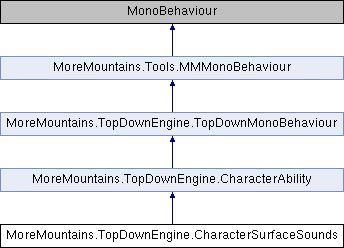
Add this component to a character and it'll let you define a number of surfaces and associate walk and run sounds to them It will also let you trigger events when entering or exiting these surfaces Important : Surfaces are evaluated from top to bottom. The first surface definition that matches the current detected ground will be considered the current surface. So make sure your order them accordingly. More...
Classes | |
| class | CharacterSurfaceSoundsItems |
Public Types | |
| enum | DimensionModes { DimensionModes.TwoD, DimensionModes.ThreeD } |
| the different dimensions detection can operate on (either 2D or 3D physics) More... | |
| enum | SurfaceDetectionModes { SurfaceDetectionModes.Raycast, SurfaceDetectionModes.Script } |
| whether detection should rely on periodical raycasts or be driven by an external script (via the SetCurrentSurfaceIndex(int index) method) More... | |
Public Member Functions | |
| override string | HelpBoxText () |
| This method is only used to display a helpbox text at the beginning of the ability's inspector. More... | |
| virtual void | SetCurrentSurfaceIndex (int index) |
| A method you can use to force the surface index, when in ScriptDriven mode More... | |
| override void | ProcessAbility () |
| Every frame we detect surfaces if needed, and handle a potential surface change More... | |
 Public Member Functions inherited from MoreMountains.TopDownEngine.CharacterAbility Public Member Functions inherited from MoreMountains.TopDownEngine.CharacterAbility | |
| delegate void | AbilityEvent () |
| virtual void | ForceInitialization () |
| Call this any time you want to force this ability to initialize (again) More... | |
| virtual void | ResetInput () |
| Resets all input for this ability. Can be overridden for ability specific directives More... | |
| virtual void | EarlyProcessAbility () |
| The first of the 3 passes you can have in your ability. Think of it as EarlyUpdate() if it existed More... | |
| virtual void | LateProcessAbility () |
| The last of the 3 passes you can have in your ability. Think of it as LateUpdate() More... | |
| virtual void | UpdateAnimator () |
| Override this to send parameters to the character's animator. This is called once per cycle, by the Character class, after Early, normal and Late process(). More... | |
| virtual void | PermitAbility (bool abilityPermitted) |
| Changes the status of the ability's permission More... | |
| virtual void | Flip () |
| Override this to specify what should happen in this ability when the character flips More... | |
| virtual void | ResetAbility () |
| Override this to reset this ability's parameters. It'll be automatically called when the character gets killed, in anticipation for its respawn. More... | |
| virtual void | SetInputManager (InputManager newInputManager) |
| Changes the reference to the input manager with the one set in parameters More... | |
| virtual void | PlayAbilityStartSfx () |
| Plays the ability start sound effect More... | |
| virtual void | PlayAbilityUsedSfx () |
| Plays the ability used sound effect More... | |
| virtual void | StopAbilityUsedSfx () |
| Stops the ability used sound effect More... | |
| virtual void | PlayAbilityStopSfx () |
| Plays the ability stop sound effect More... | |
| virtual void | PlayAbilityStartFeedbacks () |
| Plays the ability start sound effect More... | |
| virtual void | StopStartFeedbacks () |
| Stops the ability used sound effect More... | |
| virtual void | PlayAbilityStopFeedbacks () |
| Plays the ability stop sound effect More... | |
Public Attributes | |
| List< CharacterSurfaceSoundsItems > | Surfaces |
| a list of surface definitions, defined by a layer, an optional tag, and a walk and run sound. These will be evaluated from top to bottom, first match found becomes the current surface. More... | |
| DimensionModes | DimensionMode = DimensionModes.ThreeD |
| the different dimensions detection can operate on (either 2D or 3D physics) More... | |
| SurfaceDetectionModes | SurfaceDetectionMode = SurfaceDetectionModes.Raycast |
| whether detection should rely on periodical raycasts or be driven by an external script (via the SetCurrentSurfaceIndex(int index) method) More... | |
| float | RaycastLength = 2f |
| the length of the raycast to cast to detect surfaces More... | |
| Vector3 | RaycastDirection = Vector3.down |
| the direction of the raycast to cast to detect surfaces More... | |
| float | RaycastFrequency = 1f |
| the frequency (in seconds) at which to cast the raycast to detect surfaces, usually you'll want to space them a bit to save on performance More... | |
| int | CurrentSurfaceIndex = -1 |
| The current index of the surface we're on in the Surfaces list. More... | |
| Public Attributes inherited from MoreMountains.TopDownEngine.CharacterAbility | |
| AudioClip | AbilityStartSfx |
| the sound fx to play when the ability starts More... | |
| AudioClip | AbilityInProgressSfx |
| the sound fx to play while the ability is running More... | |
| AudioClip | AbilityStopSfx |
| the sound fx to play when the ability stops More... | |
| MMFeedbacks | AbilityStartFeedbacks |
| the feedbacks to play when the ability starts More... | |
| MMFeedbacks | AbilityStopFeedbacks |
| the feedbacks to play when the ability stops More... | |
| bool | AbilityPermitted = true |
| if true, this ability can perform as usual, if not, it'll be ignored. You can use this to unlock abilities over time for example More... | |
| CharacterStates.MovementStates[] | BlockingMovementStates |
| an array containing all the blocking movement states. If the Character is in one of these states and tries to trigger this ability, it won't be permitted. Useful to prevent this ability from being used while Idle or Swimming, for example. More... | |
| CharacterStates.CharacterConditions[] | BlockingConditionStates |
| an array containing all the blocking condition states. If the Character is in one of these states and tries to trigger this ability, it won't be permitted. Useful to prevent this ability from being used while dead, for example. More... | |
| Weapon.WeaponStates[] | BlockingWeaponStates |
| an array containing all the blocking weapon states. If one of the character's weapons is in one of these states and yet the character tries to trigger this ability, it won't be permitted. Useful to prevent this ability from being used while attacking, for example. More... | |
| AbilityEvent | OnAbilityStart |
| AbilityEvent | OnAbilityStop |
Protected Member Functions | |
| override void | Initialization () |
| On init we grab our run ability and init our layermasks More... | |
| virtual void | HandleSurfaceChange () |
| If we're on a new surface, we swap sounds and invoke our events More... | |
| virtual void | DetectSurfaces3D () |
| Casts rays to detect surfaces that may match our surface list's layers and tags More... | |
| virtual void | DetectSurfaces2D () |
| Tests a point under the character to try and find a surface, then compares it to the list of surfaces to find a match More... | |
| virtual bool | TagsMatch (bool useTag, string contactTag, string surfaceTag) |
| Returns true if the tags match or if we're not using tags More... | |
| virtual void | DetectSurface () |
| Checks if a surface detection is needed and performs it More... | |
| Protected Member Functions inherited from MoreMountains.TopDownEngine.CharacterAbility | |
| virtual void | Awake () |
| On awake we proceed to pre initializing our ability More... | |
| virtual void | Start () |
| On Start(), we call the ability's intialization More... | |
| virtual void | PreInitialization () |
| A method you can override to have an initialization before the actual initialization More... | |
| virtual void | BindAnimator () |
| Binds the animator from the character and initializes the animator parameters More... | |
| virtual void | InitializeAnimatorParameters () |
| Adds required animator parameters to the animator parameters list if they exist More... | |
| virtual void | InternalHandleInput () |
| Internal method to check if an input manager is present or not More... | |
| virtual void | HandleInput () |
| Called at the very start of the ability's cycle, and intended to be overridden, looks for input and calls methods if conditions are met More... | |
| virtual void | RegisterAnimatorParameter (string parameterName, AnimatorControllerParameterType parameterType, out int parameter) |
| Registers a new animator parameter to the list More... | |
| virtual void | OnRespawn () |
| Override this to describe what should happen to this ability when the character respawns More... | |
| virtual void | OnDeath () |
| Override this to describe what should happen to this ability when the character respawns More... | |
| virtual void | OnHit () |
| Override this to describe what should happen to this ability when the character takes a hit More... | |
| virtual void | OnEnable () |
| On enable, we bind our respawn delegate More... | |
| virtual void | OnDisable () |
| On disable, we unbind our respawn delegate More... | |
Protected Attributes | |
| RaycastHit | _raycastDownHit |
| LayerMask | _raycastLayerMask |
| float | _timeSinceLastCheck = -float.PositiveInfinity |
| int | _surfaceIndexLastFrame |
| CharacterRun | _characterRun |
| Collider2D | _testSurface2D |
| Protected Attributes inherited from MoreMountains.TopDownEngine.CharacterAbility | |
| Character | _character |
| TopDownController | _controller |
| TopDownController2D | _controller2D |
| TopDownController3D | _controller3D |
| GameObject | _model |
| Health | _health |
| CharacterMovement | _characterMovement |
| InputManager | _inputManager |
| Animator | _animator = null |
| CharacterStates | _state |
| SpriteRenderer | _spriteRenderer |
| MMStateMachine< CharacterStates.MovementStates > | _movement |
| MMStateMachine< CharacterStates.CharacterConditions > | _condition |
| AudioSource | _abilityInProgressSfx |
| bool | _abilityInitialized = false |
| float | _verticalInput |
| float | _horizontalInput |
| bool | _startFeedbackIsPlaying = false |
| List< CharacterHandleWeapon > | _handleWeaponList |
Additional Inherited Members | |
| Properties inherited from MoreMountains.TopDownEngine.CharacterAbility | |
| virtual bool | AbilityAuthorized [get] |
| virtual bool | AbilityInitialized [get] |
| whether or not this ability has been initialized More... | |
Add this component to a character and it'll let you define a number of surfaces and associate walk and run sounds to them It will also let you trigger events when entering or exiting these surfaces Important : Surfaces are evaluated from top to bottom. The first surface definition that matches the current detected ground will be considered the current surface. So make sure your order them accordingly.
whether detection should rely on periodical raycasts or be driven by an external script (via the SetCurrentSurfaceIndex(int index) method)
| Enumerator | |
|---|---|
| Raycast | |
| Script | |
|
protectedvirtual |
Checks if a surface detection is needed and performs it
|
protectedvirtual |
Tests a point under the character to try and find a surface, then compares it to the list of surfaces to find a match
|
protectedvirtual |
Casts rays to detect surfaces that may match our surface list's layers and tags
|
protectedvirtual |
If we're on a new surface, we swap sounds and invoke our events
|
virtual |
This method is only used to display a helpbox text at the beginning of the ability's inspector.
Reimplemented from MoreMountains.TopDownEngine.CharacterAbility.
|
protectedvirtual |
On init we grab our run ability and init our layermasks
Reimplemented from MoreMountains.TopDownEngine.CharacterAbility.
|
virtual |
Every frame we detect surfaces if needed, and handle a potential surface change
Reimplemented from MoreMountains.TopDownEngine.CharacterAbility.
|
virtual |
A method you can use to force the surface index, when in ScriptDriven mode
| index |
|
protectedvirtual |
Returns true if the tags match or if we're not using tags
| useTag | |
| contactTag | |
| surfaceTag |
|
protected |
|
protected |
|
protected |
|
protected |
|
protected |
|
protected |
| int MoreMountains.TopDownEngine.CharacterSurfaceSounds.CurrentSurfaceIndex = -1 |
The current index of the surface we're on in the Surfaces list.
| DimensionModes MoreMountains.TopDownEngine.CharacterSurfaceSounds.DimensionMode = DimensionModes.ThreeD |
the different dimensions detection can operate on (either 2D or 3D physics)
| Vector3 MoreMountains.TopDownEngine.CharacterSurfaceSounds.RaycastDirection = Vector3.down |
the direction of the raycast to cast to detect surfaces
| float MoreMountains.TopDownEngine.CharacterSurfaceSounds.RaycastFrequency = 1f |
the frequency (in seconds) at which to cast the raycast to detect surfaces, usually you'll want to space them a bit to save on performance
| float MoreMountains.TopDownEngine.CharacterSurfaceSounds.RaycastLength = 2f |
the length of the raycast to cast to detect surfaces
| SurfaceDetectionModes MoreMountains.TopDownEngine.CharacterSurfaceSounds.SurfaceDetectionMode = SurfaceDetectionModes.Raycast |
whether detection should rely on periodical raycasts or be driven by an external script (via the SetCurrentSurfaceIndex(int index) method)
| List<CharacterSurfaceSoundsItems> MoreMountains.TopDownEngine.CharacterSurfaceSounds.Surfaces |
a list of surface definitions, defined by a layer, an optional tag, and a walk and run sound. These will be evaluated from top to bottom, first match found becomes the current surface.
 1.8.18